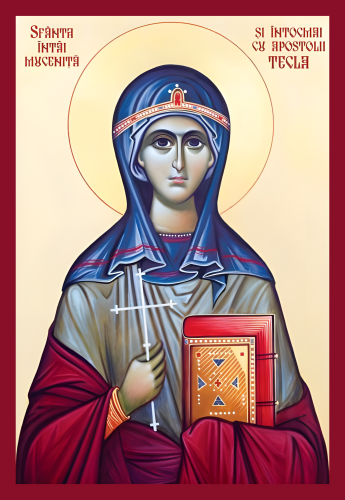
St Thecla is one of the most revered figures of early Christianity, recognized as the first female martyr and considered ‘just like the Apostles.’ Her life, full of courage and miracles, remains a source of inspiration for all who seek to follow their faith with devotion. Born into an environment hostile to Christianity, Thecla chose to dedicate her life to Christ, defying the social norms of her time.
Her story is a timeless example of resilience in the face of adversity, unwavering faith and love of neighbor. Through our Foundation’s activities, we strive to carry on her values and teachings, inspiring hope and solidarity in the community.
St. Thecla was born in the 1st century AD in the city of Iconium (now Konya, Turkey) into a wealthy family. At the age of 18, her life was radically changed when she met St. Paul the Apostle, who was preaching the Christian faith in the house of Onysiphorus. Fascinated by his teachings of chastity and dedication to Christ, Thecla decided to follow her faith, defying the pressures of family and society.
Throughout her life, Thecla faced severe persecution from the authorities and her family. She was condemned to death by burning at the stake, but escaped unharmed thanks to a miraculous rain that extinguished the fire. She was later thrown to the gallows in the amphitheater of Antioch, but the animals did not attack her. These miracles became symbols of divine protection and inspired Christian communities to keep their faith despite persecution.
St. Thecla lived to the venerable age of 90, dedicating herself to preaching the Gospel and serving her neighbor. Her courage and sacrifice continues to inspire millions of believers around the world.
St Thecla is celebrated on September 24, a special day in the Christian calendar dedicated to the memory of her courage and devotion. In many regions, this day is marked by special prayers for the protection of families, households and animals, and is associated with protection against natural dangers.
In rural communities, St. Thecla’s Day is celebrated with religious processions, blessing of flocks and households and participation in solemn services. The faithful also light candles and say prayers for health and prosperity. These traditions not only honor the memory of the Saint, but create a strong sense of spiritual unity among the faithful.
The Church and communities dedicated to St. Thecla preserve numerous heirlooms that reflect the deep bond between the faithful and this religious figure. Among the most valuable relics are the relics of the saint, kept at the Monastery of St Thecla in Maaloula, Syria. Icons dedicated to her, often depicting her with St. Paul the Apostle, are also venerable symbols of faith.
These objects are not just artistic treasures, but living testimonies of faith and sacrifice. By displaying them, communities express their respect for St Thecla and pass on Christian values. St Thecla’s religious heritage continues to inspire artists, believers and generations of people who find hope in her story.
The Church and communities dedicated to St. Thecla preserve numerous heirlooms that reflect the deep bond between the faithful and this religious figure. Among the most valuable relics are the relics of the saint, kept at the Monastery of St Thecla in Maaloula, Syria. Icons dedicated to her, often depicting her with St. Paul the Apostle, are also venerable symbols of faith.
These objects are not just artistic treasures, but living testimonies of faith and sacrifice. By displaying them, communities express their respect for St Thecla and pass on Christian values. St Thecla’s religious heritage continues to inspire artists, believers and generations of people who find hope in her story.